

If you've heard the term "agentic AI" in the past year, you're not alone. It's become the buzzword of choice for everything from coding assistants to customer service bots to—inevitably—project management tools. Vendors promise agents that will "autonomously manage your workflows" and "proactively handle tasks." Before dismissing this as hype (tempting) or buying in completely (risky), it's worth understanding what an agentic loop actually is, where the idea came from, and why it's suddenly working. For project managers especially, the pattern turns out to be surprisingly familiar—and understanding it clarifies both where AI can help and where it can't.
The loop, explained simply
At its core, an agentic loop is a cycle: Perceive → Reason → Act → Observe → Repeat
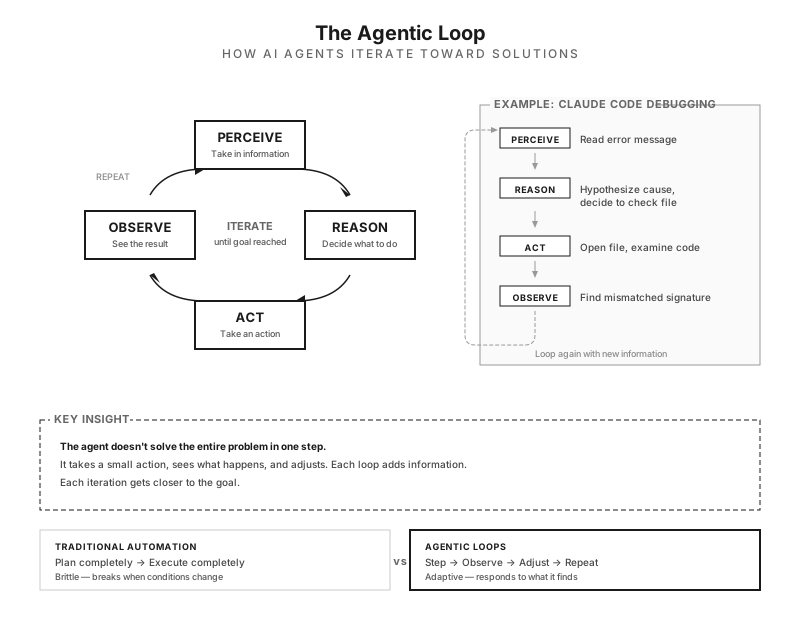
The agent takes in information from its environment. It thinks about what to do. It takes an action. It observes the result. Then it loops back—perceiving the new state, reasoning again, acting again. That's it. The power isn't in any single step. It's in the iteration.
Consider how Claude Code works when debugging. It reads the error message (perceive). It hypothesizes what's wrong and decides to check a specific file (reason). It opens the file and examines the code (act). It sees that the function signature doesn't match the call (observe). Now it loops: with this new information, it reasons about a fix, makes an edit, runs the test again, and observes whether the error is resolved.
The key insight is that the agent doesn't try to solve the entire problem in one step. It takes a small action, sees what happens, and adjusts. Each loop adds information. Each iteration gets closer to the goal. This is fundamentally different from the traditional automation model, where you define the complete workflow upfront and the system executes it exactly. Traditional automation is brittle—it breaks when conditions change. Agentic loops are adaptive—they respond to what they find.
Where this came from
The concept isn't new. It emerged from AI research in the 1980s and 1990s, when researchers were trying to answer a fundamental question: how do you build systems that can operate in uncertain, dynamic environments? The early AI approach—symbolic reasoning, expert systems—assumed you could model the world completely and plan accordingly. It worked in constrained domains like chess. It failed catastrophically in the real world, where conditions change, information is incomplete, and actions have unpredictable effects.
The response was a shift toward what researchers called "situated" or "reactive" agents. Instead of elaborate planning, these systems used tight feedback loops. Sense the environment, respond, sense again. Rodney Brooks at MIT built robots that navigated rooms without internal maps—they simply reacted to what their sensors detected, moment by moment.
The theoretical framework that emerged—often called the BDI model (Beliefs, Desires, Intentions)—formalized how agents should balance goals against changing circumstances. Russell and Norvig's Artificial Intelligence: A Modern Approach, the field's standard textbook since 1995, codified the loop as the basic structure of rational agents. But there was a problem. These agents were narrow. A robot could navigate a room, but couldn't hold a conversation. A chess engine could reason about board positions, but couldn't explain its thinking. Building an agent required hand-coding its perception, reasoning, and action capabilities for each specific domain. The idea was right. The engine wasn't powerful enough.
Why it's working now
Large language models changed the equation. An LLM can interpret ambiguous, natural-language inputs—the way humans describe problems, not the way databases store data. It can reason across domains, drawing on patterns from training data spanning code, business documents, scientific papers, and ordinary conversation. And crucially, it can generate structured outputs: function calls, API requests, tool invocations.
The breakthrough paper came in 2022. Researchers at Princeton and Google introduced ReAct (Reasoning + Acting), a pattern where the model alternates between thinking out loud and taking actions. Instead of trying to answer in one shot, the model reasons about what it needs to know, takes an action to get that information, observes the result, and reasons again.
This unlocked the agentic loop for general-purpose tasks. The LLM became the reasoning engine that the pattern had always needed. Production tools followed quickly. Claude Code, Cursor, and GitHub Copilot's agent mode all implement variations of the loop. They perceive (read files, error messages, user requests), reason (decide what to investigate or change), act (edit code, run commands, search documentation), and observe (check test results, read outputs). They iterate until the task is done or they get stuck.
The results in coding have been striking enough that the question is now obvious: where else does this pattern apply?
Why it should feel familiar
Here's the thing: if you've managed projects, you already think in loops. The PDCA cycle—Plan, Do, Check, Act—has been a cornerstone of quality management since Deming popularized it in the 1950s. You make a plan, execute it, check the results, and adjust. Then you loop again.
Agile methodologies are explicitly iterative. Sprints are loops. The daily standup is a feedback mechanism. The retrospective is observation informing the next iteration. The Agile Manifesto's preference for "responding to change over following a plan" is precisely the philosophy behind agentic systems.
Even the OODA loop from military strategy—Observe, Orient, Decide, Act—follows the same structure. Colonel John Boyd developed it to explain how fighter pilots succeed: not by having better plans, but by cycling through the loop faster than opponents.
The agentic AI loop is the same pattern, running at machine speed. This is why the architecture maps so naturally to project management. A PM's job is fundamentally about loops: monitor status, identify issues, decide on responses, take action, monitor again. The question isn't whether loops apply—it's which loops can run faster and which require human judgment.
The virtue of the loop
Why does this pattern work so well? Three reasons stand out:
It handles uncertainty. Real environments are unpredictable. Requirements change. Stakeholders shift priorities. Systems behave unexpectedly. A loop-based approach doesn't require perfect foresight—it discovers conditions as it goes and adapts.
It makes progress legible. Each iteration produces observable results. You can see what the agent tried, what it learned, and how its approach evolved. This is far more auditable than a black-box system that produces answers with no visible reasoning.
It bounds failure. When an individual action fails, the loop can detect the failure and try something else. Errors are local, not catastrophic. Compare this to a fully planned approach where a wrong assumption in step three invalidates everything that follows.
For PMs, these virtues map directly to how good projects work. You don't plan every detail upfront because you know conditions will change. You build in checkpoints because visibility matters. You design for recovery because things go wrong. The agentic loop is a formalization of adaptive practice.
What this means for AI in project management
Understanding the loop clarifies what AI tools can and can't do. They can run fast, tight iterations on well-defined tasks with clear feedback signals. Consolidate status from five systems into a report—that's a loop with a definable goal and observable output. Draft a stakeholder email—that's a loop that can iterate on tone and content until criteria are met.
They struggle with slow, ambiguous loops where feedback is delayed or political. Determine whether the steering committee will approve the change request—that requires context no AI has access to, and the feedback takes weeks, not seconds.
The architectural insight from the previous article holds: project management is nested loops. Fast inner loops (status, communication, risk monitoring) can run at machine speed. The slow outer loop (project lifecycle, stakeholder relationships, strategic judgment) remains human. AI doesn't replace the PM. It runs the inner loops and feeds intelligence up to the human, who runs the outer loop and sends decisions down. The agentic pattern enables this by making the boundary explicit: loops with fast, clear feedback go to the machine; loops with slow, ambiguous feedback stay with the human.
The practical takeaway
When vendors pitch "AI agents for project management," you now have a framework for evaluation. Ask: what's the loop? What does the agent perceive, and from what sources? What actions can it take? What signals tell it whether an action succeeded? How fast does it iterate? If the answers are clear—it reads Jira and Slack, drafts status updates, checks whether the format matches the template, iterates until done—you're looking at a legitimate inner loop. If the answers are vague—it "manages stakeholder relationships" or "optimizes project outcomes"—you're looking at marketing.
The agentic loop is a powerful pattern. It's been refined over decades of research and proven in production coding tools. Applied to the right problems—fast, well-defined, clear feedback—it can automate work that currently consumes hours of PM time. Applied to the wrong problems, it's just another overpromise. The PMs who benefit most will be those who understand the loop well enough to know the difference.
