
How a browser adventure became a comic that draws itself inside an AI chat.
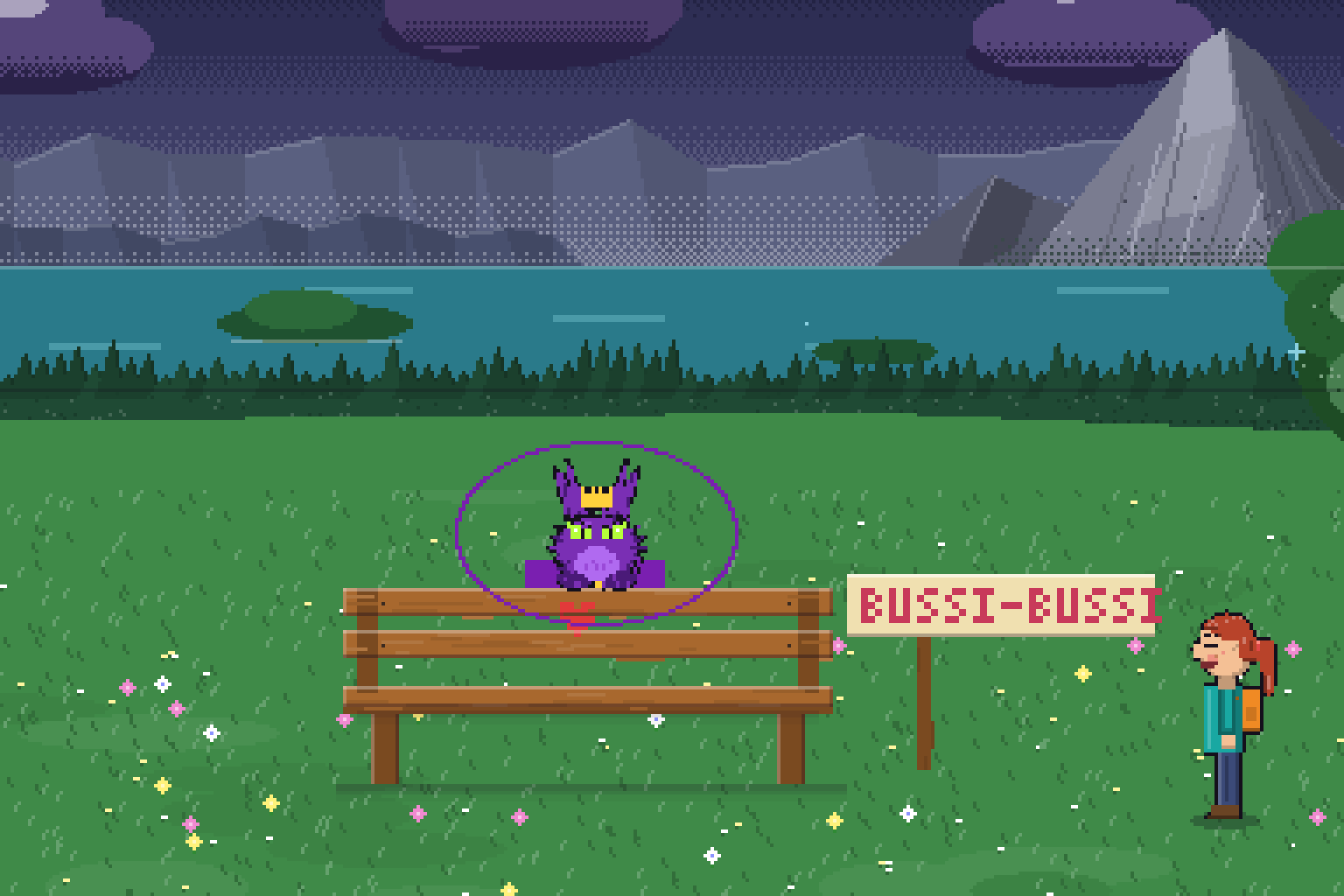
I run a holiday farm above Lake Faak, and the farm has a point-and-click adventure. In Das Wiesenscheißerle vom Ulbinghof, a tourist and a grandmother with very strong coffee stop a fluffy meadow creature from taking over the world. It takes about an hour to play, and its code is a single HTML file of about a megabyte.
When I wanted it to be playable inside an AI chat, I did the obvious thing first and embedded it. MCP Apps, which became an official extension in January, lets a server show an interface inside the conversation, and by April Chris Nager had DOOM running that way. My server sends the game file almost unchanged, with a small bridge script that starts it once the chat client is ready.
It worked, and I found it uninspired. All it did was put the finished game in a frame.
So I turned the game into a comic that draws itself while you play.
The coding agent I was building with mocked up five versions made for a chat, among them text messages from the heroine, a village newspaper and a radio play. I picked the comic. It is called Das Heft, the booklet.
In Das Heft you never see the game itself. You tap something in the last panel, and the result arrives as new panels. Take the cuckoo clock on the first floor, which shouts “SCHEISSERLE!” and keeps a guest from sleeping. Use the cork on it, and two panels appear. In the first, Mila waits for the little door to open and the clock gets as far as “SCHEISS…”. In the second, the bubble above the clock reads “…MMPF!”.
My first version made every page of the comic its own card. Once a page was full, the comic posted the player’s next action into the chat as a message, the assistant called a tool, and a new card continued the story. In Claude that failed twice over. The client asked for permission every time the app wanted to send a message, which was every four or five taps, and each new card arrived with the chat scrolled to its bottom while the new panels were at its top.
My own test host had shown me none of this.
So the comic now plays in a single card with a fixed height. A page holds about nine panels, pages turn inside the card, and a tap involves no model. The assistant comes in when the player asks for a hint or types what the heroine should do. In the second case it opens a new card that carries out those steps, with one line of narration to lead into it.
The agent’s first proposal was to rebuild the game’s rules on the server, since every chat turn passes through it. It dropped that before writing a line. The game has hundreds of responses to things a player might try. A port would be a second implementation of all of it, and a second implementation slowly stops matching the first.
Instead, every comic page loads the real game and runs it out of sight. A script wraps the engine’s functions for speech, narration, sound effects and inventory, so that each call is recorded as an event, and it takes a snapshot of the canvas at every spoken line. A second piece of code, the director, turns those events into panels. It crops around whoever is speaking, puts bubbles above heads and sets narration in caption boxes. Thunder gets a full row.
The game’s source file is not edited for any of this. Its behaviour at run time is, because of the next problem.
A chat client can discard a card’s iframe and create it again later, for instance when the conversation is reopened. A card that keeps its state in memory will lose it, so every card has to be able to redraw itself from nothing.
The server therefore keeps no game state. For each comic it stores the ordered list of the player’s steps and a seed. A card starts a fresh game, replays the whole list at full speed, and draws the page it is asked to show.
Replay produces the same panels only if the engine is deterministic, and a browser game is not. So the comic script takes over the two things that vary. Math.random is reseeded before every step from that seed and the step number. The engine’s real-time clock is replaced by a rule that every action costs eight seconds of game time. Without that rule, the heroine’s rowanberry schnapps, which lets her understand the cellar ghost for four minutes, would wear off while someone was reading.
Regular readers will recognise this. It is the stateless loop with externalised state that I keep arguing for, applied to a user interface. A view can be thrown away at any time, because the list on the server is the only state that counts.
Replay is also cheap. The export view replayed a finished run and drew every page in under four seconds, measured once in a desktop browser. What I have not measured is memory. Every card holds a complete copy of the engine, and a conversation gains a card each time the assistant acts.
The assistant is the second participant in a chat, and the protocol gives it no direct way into a view that is already open on the user’s screen. Its tool calls go to the server. The embedded version of the game needs a queue for that, which the game view polls. The comic does not, because the assistant’s steps simply open a new card.
In the other direction, the page writes a plain-text report after each action: the room, the visible objects with their ids, the inventory, any open dialog options. That report is what the assistant reads.
To see how far this goes, I connected the server to Claude and asked it to play the comic to the end. It did, in 88 actions and 221 panels, without seeing a single picture. It read the reports and answered with verbs and ids, which is how adventure games were played before they had graphics.
None of this needed special hosting. The protocol endpoint is 108 lines of PHP on the farm’s shared web space, and it returns plain JSON without streaming or sign-in. That figure covers the endpoint only. The app tools are about 480 more lines of PHP and the comic script is about 660 lines of JavaScript, and all of it sits on top of a game that already existed.
You can try it yourself. The server needs no account and no sign-in. The menu names below are those of the English interfaces in November 2026.
- In Claude, add a custom connector: go to Customize > Connectors, click Add custom connector, enter
https://www.ulbinghof.at/mcpand click Add. On the Free plan this is your one custom connector. In a chat, check under + > Connectors that Ulbinghof is switched on, then ask for the Ulbinghof comic. - In ChatGPT on the web, add a custom MCP server: open Plugins, select the plus button and choose Add custom MCP server. Enter a name, use
https://www.ulbinghof.at/mcpas the server URL, choose No authentication, confirm the warning and select Create as a plugin. Install the plugin, then type @ in a chat, select it and ask for the comic. Your plan has to allow custom MCP servers.
What I have not solved is a problem that this design created. A list of steps is a save game only for the exact engine that recorded it. If I change one puzzle, or the order of two calls to the random generator, the later steps of every stored comic are applied to a different game. Nothing in the stored record even names the engine it was played against. The exported file is safe, because its panels are images, but the save inside it is the same list.
Recording the engine version would tell me which engine a comic needs. It would not bring that engine back.