

If you've watched developers work with Claude Code or Cursor over the past year, you've seen something genuinely new: not AI as autocomplete, but AI as a collaborator running tight, iterative loops. The tool takes a problem, gathers context, executes against the codebase, checks its work, and iterates until something compiles and passes tests.
It's natural to ask: can this architecture work for project management? The endless status consolidation, stakeholder communication, and documentation churn seems like an obvious candidate. If an agentic loop can write and debug code, surely it can draft a status report or flag a slipping deadline. The answer is yes—but with a critical constraint. Project management splits cleanly into two kinds of work: mechanical loops that AI can run at machine speed, and judgment-heavy outer loops that require human presence, relationships, and political awareness. The architecture works only if we accept that boundary.
Parallels
The structure maps cleanly. Coding loops take input (a problem), gather context (codebase, dependencies, tests), use tools (file operations, terminal, git), and iterate toward working code. Project management has the same bones: objectives as input, project status as context, email and Jira and Slack as tools, and the familiar rhythm of plan-execute-monitor-adjust. The parallel is real—but incomplete in ways that matter.
Limits
Code does what you tell it. Tests pass or fail with objective finality. People have agency, politics, and emotions. The "passing test" equivalent in project management—stakeholder approval—is subjective and revocable. A sponsor who signed off Tuesday can change their mind after a hallway conversation Thursday. Claude Code can actually write the file and run the test. An AI PM assistant can draft the escalation email—but it cannot make the stakeholder respond, and escalating to the wrong person at the wrong moment can make things worse even when the risk assessment is technically correct.
The execution boundary stops at the human interface.
There's also a brutal latency mismatch. Coding loops iterate in seconds to minutes. PM loops run on timescales of days and weeks. You cannot iterate at machine speed when your "tools" are humans who take three days to respond to email.
State persistence presents another challenge. Code has git—explicit, versioned, recoverable. PM state is distributed across email threads, hallway conversations, and relationship history that never gets documented. The context window problem in PM is orders of magnitude harder.
And success criteria differ fundamentally. In code, tests pass and builds work. In PM, success is multidimensional, political, and often retrospectively redefined. The feedback signal is noisy, delayed, and filtered through organizational dynamics the AI cannot see.
The Nested Loop
Consider a concrete example: the weekly status report.
Today, a project manager spends hours querying Jira for task status, scanning Slack for blockers mentioned in passing, checking email for stakeholder concerns, reconciling calendar conflicts, and synthesizing it all into a coherent narrative. This is an inner loop (mechanical execution)—repetitive and amenable to automation.
But deciding what to emphasize in that report? Knowing that the CFO cares about burn rate while the product sponsor cares about feature completeness? Understanding that mentioning the infrastructure delay will trigger a political chain reaction? That's the outer loop (human judgment)—slow, context-dependent, and irreducibly human.
The architecture that works is nested loops. The outer loop is human-paced and human-owned: the project lifecycle of initiate, plan, execute, monitor, close. Decision checkpoints at each transition. Relationships, politics, situational awareness. Cannot be automated.
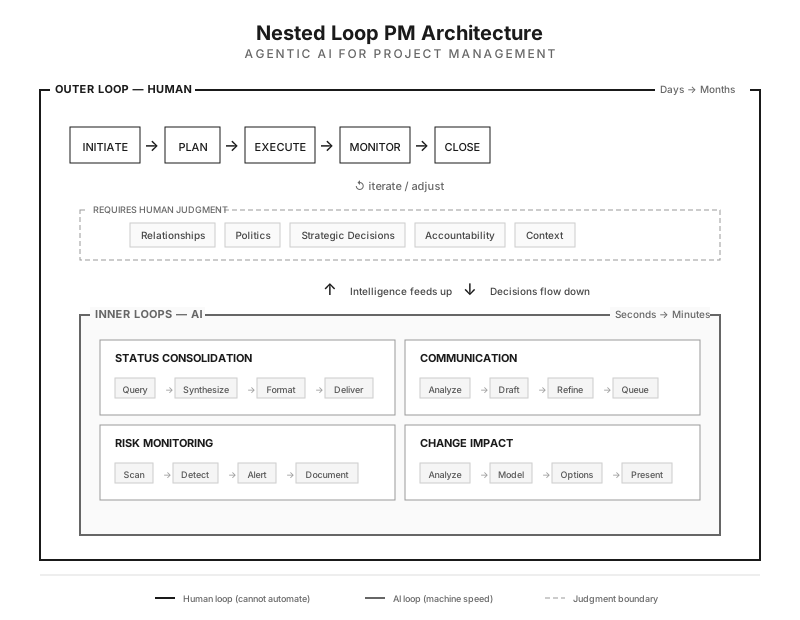
Inside sit multiple inner loops that can run at machine speed:
- Status consolidation: Query sources → synthesize → format → deliver
- Communication drafting: Analyze input → draft → refine → queue for review
- Risk monitoring: Scan data → detect patterns → alert → document
- Change impact modeling: Analyze request → model timeline/budget impact → present options
The AI runs the inner loops and feeds intelligence up to the human. The human makes judgment calls and sends decisions down for execution. This mirrors how Claude Code actually works—nobody uses it to write entire applications autonomously. Developers handle discrete tasks in tight loops. A PM engine would do the same.
What this actually looks like
In practice, it's a supercharged combination of Notion, Linear, and an email agent:
The deliverable loop: A deadline approaches. The system queries status in the tracker, scans related email threads, checks calendar for blockers. It outputs a risk assessment with options. The human reviews—escalate, adjust plan, or override. The system sends communications and updates trackers. Then monitors for responses.
The change request loop: A stakeholder email arrives with scope change. The system analyzes impact on timeline and budget, queries historical similar changes and current resource load. It outputs an assessment with options: accept, reject, negotiate. The human decides. The system documents and communicates.
These inner loops have clear termination conditions. The report is generated. The email is drafted. The risk is flagged. Success is measurable at the loop level even when project-level success remains ambiguous.
But the trade-offs are real. Latency versus freshness: how often should the system re-query sources? Over-automation versus trust erosion: when humans stop reading drafts carefully, errors slip through. Context depth versus privacy: analyzing email sentiment and response patterns is powerful intelligence for a PM—and dangerously close to performance surveillance if governance is weak.
Where this fails
The feedback signal problem haunts the whole approach. In coding, tests pass or fail. In PM, how does the system know if the status report was effective? If the stakeholder communication landed? Feedback is delayed, noisy, often implicit. You can optimize inner loops on their own terms—report generated, email sent—but you cannot easily measure whether they served the project.
The rubber-stamp problem is insidious. AI drafts, human approves. But approval becomes automatic when humans trust too much. AI mistakes come wrapped in perfect confidence. The architecture needs to force meaningful review, not just create checkpoints that become reflexive clicks.
What happens when the AI optimizes for visible metrics? Sprint velocity looks great while technical debt accumulates invisibly. Status reports hit every deadline while the team burns out. Inner loops can be gamed—or can inadvertently game themselves toward measurable proxies rather than actual outcomes.
And there's context the AI will never have. The hallway conversation where the sponsor mentioned their real concern. The relationship history explaining why this client's "urgent" means something different. The political dynamics of the steering committee. Inner loops work on documented, queryable information. Outer loop judgment requires context that never makes it into any system.
What Works Now
The architecture isn't theoretical. The building blocks exist today: MCP connectors link AI to Gmail, Calendar, Slack, Jira, and Drive. Claude and GPT handle synthesis and drafting. The challenge is integration—wiring these components into loops that actually fit how project teams work. The organizations getting value now aren't waiting for a packaged "AI PM" product. They're building targeted inner loops: a status consolidation agent that queries three systems and drafts a weekly report. A change request analyzer that models timeline impact before the PM even opens the email. A risk monitor that flags patterns humans would miss in sprint data.
Each loop is narrow, testable, and connected to a human checkpoint. The discipline is knowing where to stop—automating the mechanical work without pretending the AI understands why the CFO's concerns matter more this quarter than last.
The pattern mirrors what's worked in development. Claude Code didn't succeed by promising to replace programmers. It succeeded by handling the tedious parts—boilerplate, refactoring, test generation—so developers could focus on architecture and design decisions. The same approach applies to project management: automate the information synthesis, preserve the human judgment.
Building these systems requires understanding both the AI capabilities and the PM workflows they're meant to support. The gap between "technically possible" and "actually useful" is where most implementations fail. Getting it right means starting with a specific pain point, building a minimal loop, and expanding only when the first one proves its value.
If AI ever claims to manage your project end-to-end, it's either lying—or your project was never that complex to begin with. The interesting work is in the middle: inner loops fast enough to matter, outer loops human enough to succeed.